

To achieve global climate targets, carbon dioxide removal (CDR) methods have become essential to achieving global climate targets.
Current CDR technology pathways — direct air capture, enhanced weathering, biochar production, blue-carbon restoration, silvopasture and soil-carbon systems, and BiCRS/BECCS — offer varying permanence from decades to millennia.
To certify CDR as carbon credits, projects must be implemented in accordance with detailed technical rules defined in the applicable methodology, including emissions quantification and data measurement and monitoring requirements.
The global portfolio of carbon-removal solutions includes several key approaches, each with distinct operational features and its own pathway for climate action implementation. Understanding the differences among these approaches, including technology readiness levels (TRL), storage duration, and scalability, is essential for organizations developing comprehensive decarbonization strategies.
Tech-based CDR
While CDR technology removes CO₂ already in the atmosphere, carbon capture and storage (CCS) captures emissions at industrial point sources before atmospheric release, and carbon capture and utilization (CCU) converts captured CO₂ into products. This distinction is critical for carbon-accounting methodologies and compliance reporting.
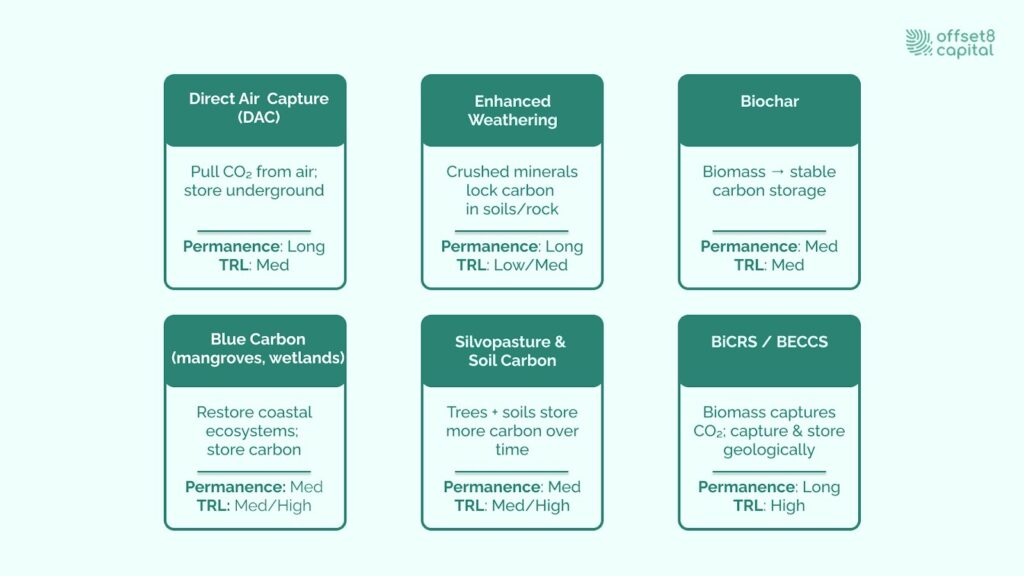
Fig 1: CDR Methods at a Glance
Direct air capture uses chemical sorbents to pull CO₂ from ambient air and can deliver millennia-scale permanence when paired with geological storage. Enhanced weathering speeds up natural mineralization by spreading crushed silicate rock on soils.
Nature-Based Carbon Dioxide Removal
Biochar production converts waste biomass into durable carbon that can sequester carbon for centuries. Verra’s VM0044 methodology, approved under ICVCM‘s Core Carbon Principles, provides a framework for quantifying this long-term sequestration and issuing certified carbon credits. Blue carbon ecosystems such as tidal wetlands, mangroves, and seagrass meadows sequester carbon rapidly. In international carbon credit standards, Verra provides the VM0033 methodology for tidal wetland and seagrass restoration, while Gold Standard offers a methodology for the sustainable management of mangroves. In Japan, there is a domestic scheme called “J-Blue Credits,” certified and issued by the Japan Blue Economy Association (JBE), which targets greenhouse gas removals from seagrass meadows, seaweed beds, and related coastal ecosystems.
Biomass Carbon Removal and Storage (BiCRS) pathways, including BECCS, capture CO₂ in biomass via photosynthesis before delivering durable removal through geological storage.
Direct air capture (DAC) has emerged as one of the most promising technologies in the field of engineered carbon removal. The DAC technology deployment is rapidly increasing as companies and governments push for solutions to combat climate change.
DAC involves capturing carbon dioxide directly from the atmosphere. According to the IEA, although DAC is currently deployed mainly through pilot projects, it is expected to scale up rapidly, reaching around 90 million tonnes of CO₂ removal per year by 2030 and just under 1 gigatonne per year by 2050.
Another crucial technology in the CDR landscape is Bioenergy with Carbon Capture and Storage (BECCS). BECCS integrates bioenergy generation with carbon capture, offering scalability and cost-effective potential, particularly in regions rich in forestry and geological storage infrastructure.
The CDR technology deployment involves a strong focus on reducing the costs of these solutions. While current removal costs are still high, with some technologies reaching prices near $1,000 per tonne of CO₂, projections suggest that prices will fall to $300–350 per tonne by 2030 as more systems are deployed, driving down capital costs and improving operational efficiency.
The trajectory of CDR deployment readiness has reached a pivotal moment, with COP30 in Belém marking the first inclusion of carbon dioxide removal in the official UN Climate Action Agenda. The Technology Readiness Level (TRL) framework — a 1-to-9 scale measuring technology maturation — reveals stark disparities across CDR methods.
BECCS and afforestation/reforestation operate at TRL 9, indicating commercial readiness, while marine CDR and enhanced weathering remain at earlier developmental stages requiring further validation. The IPCC's announcement at COP30 of a forthcoming 2027 Methodology Report on CDR Technology Deployment and Carbon Capture signals accelerating momentum for standardized implementation planning frameworks.
For institutions evaluating scalability potential, the commercial readiness assessment landscape is evolving rapidly. The newly operational Paris Agreement Crediting Mechanism (PACM) provides governance architecture for climate finance mechanisms, while initiatives like the G20's Common Carbon Credit Data Model enhance market transparency.
The carbon credit futures market continues expanding, with Q2 2025 recording increasing volumes — particularly in biomass carbon removal solutions. Climate scientists underscore the urgency: 10 billion tonnes of CO₂ must be captured annually to avoid catastrophic tipping points, demanding accelerated implementation planning across sectors and organizational scales.
Effective CDR cost analysis depends on understanding technology economics, where cost per tonne varies widely and Direct Air Capture remains the highest-cost pathway. Innovation is shifting deployment considerations, with emerging projects scaling into the 15–40 thousand tonnes of CO₂ annually.
For organizations advancing implementation planning, tools like Offtake agreements help secure demand, while premium carbon credits strengthen market positioning. Key climate finance mechanisms support ROI analysis and accelerate commercial readiness assessment. As public procurement expands, it provides performance data that further reduces costs and improves implementation planning across CDR portfolios.
Strong CDR verification frameworks rely on rigorous quality standards that ensure credible carbon removal. Verra VCS provides methodologies like VM0044, which now includes investment analysis to meet additional requirements. Puro Earth introduced the first biochar methodology with strict permanence criteria and independent third-party verification.
Advanced MRV systems continue to evolve, with Isometric setting some of the most stringent protocols for engineered removals. Across the sector, due diligence protocols within high-integrity standards help manage risk, uphold credit vintage requirements, and ensure durable, verifiable climate outcomes.
Global CDR deployment patterns reveal distinct advantages tied to natural resource availability and evolving regional project development frameworks. Sub-Saharan Africa projects demonstrate exceptional potentia.
Middle East regulatory frameworks increasingly support climate finance flows to these regions. Japan's Joint Crediting Mechanism (JCM), now encompassing 31 partner countries, provides structured implementation examples for bilateral credit generation under Article 6.2. These diverse regional deployments demonstrate how CDR project development can simultaneously address climate objectives and deliver measurable socio-economic co-benefits to local communities.
The trajectory of CDR future development is directly tied to achieving the 1.5°C temperature target. IPCC scenarios show that meeting 1.5°C requires net-zero CO₂ by the early 2050s and 6–10 Gt/year of CDR, while today’s 41 Mt/year highlights a major scaling projection gap across the global technology roadmap.
Innovation pathways suggest steep cost declines: DACCS may fall to $100–600/tonne by 2050. Growing demand and market scaling projections — from a $2B market today to potentially $250B by 2035 — underscore that achieving climate objectives will require sustained investment in technology, infrastructure, and supportive policy frameworks.
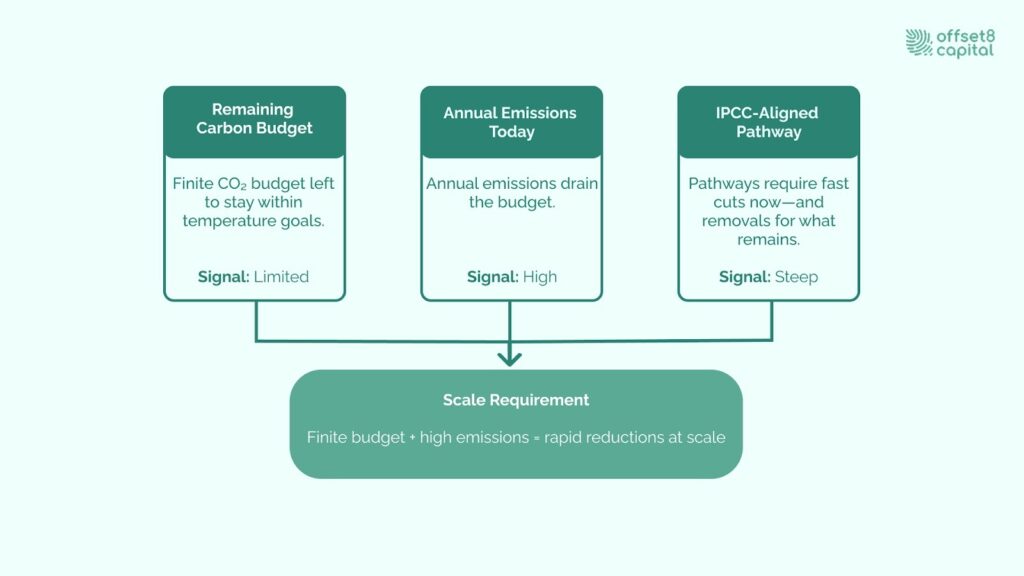
Fig 2: A finite budget requires scale
Policy evolution is shaping this shift. The EU’s Carbon Removal Certification Framework (CRCF) establishes harmonized policy support mechanisms for carbon removal, and regulatory evolution continues as countries explore integrating durable CDR into carbon markets post-2030.
The CRCF certifies the carbon removal technologies like DAC, BECCS, and carbon farming. This ensures high environmental integrity and long-term carbon storage, supporting the EU’s climate goals of achieving carbon neutrality by 2050.
As carbon removal technologies become more cost-effective and scalable, frameworks like the CRCF will drive investments and integration into compliance markets. This will increase the demand for certified carbon credits and likely lead to higher prices for durable credits.
More broadly, as the deployment of carbon removal solutions expands, there is growing recognition that robust certification frameworks are essential for maintaining market credibility. In this context, the EU’s CRCF provides common standards for carbon removal and plays a foundational role in supporting technology development and market formation from a regulatory and institutional perspective.
CDR implementation has moved from a niche concept to a core pillar of comprehensive climate strategies. As IPCC scenarios show, achieving the 1.5°C temperature target requires pairing deep emission cuts with high-quality removals. Regulatory compliance verification through Verra VCS, Gold Standard, Isometric, and the Paris Agreement Crediting Mechanism ensures verified climate impact that meets rising scrutiny. Organizational climate action is increasingly linked to regulatory compliance verification, as organizations seek credible, transparent, and verifiable approaches to demonstrating climate impact.
Disclaimer
This commentary is for informational purposes only and should not be considered financial, investment, or regulatory advice. Offset8 Capital Limited is regulated by the ADGM FSRA (FSP No. 220178). No assurances or guarantees are made regarding its accuracy or completeness. Views expressed are our own and subject to change
Enhanced weathering and biochar can offer relatively lower deployment costs and, in some cases, demonstrated long-term carbon storage, depending on project design and the robustness of MRV systems. In contrast, Direct Air Capture (DAC), particularly when combined with geological storage, provides very high permanence assurance, although implementation costs remain higher. Method selection depends on permanence requirements, compliance timelines, jurisdictional acceptance, and organizational risk tolerance. When building CDR portfolios for regulatory compliance verification, organizations should evaluate high-integrity standards alongside cost metrics.
Article 6.2 can enable international transfers of CDR credits with corresponding adjustments, subject to the rules of participating countries and the terms of bilateral agreements. This framework supports credit integrity through transparent accounting and can facilitate recognition for compliance applications, depending on domestic implementation. Article 6.2 also enables bilateral mechanisms, such as Japan’s Joint Crediting Mechanism (JCM), which may provide pathways for verified carbon removal credits where eligibility criteria are met.
Verra VCS and Gold Standard require measures such as buffer pools, reversal monitoring, and third-party verification, alongside comprehensive MRV systems and transparent reporting protocols. Isometric applies particularly stringent requirements for engineered carbon removal, emphasizing frequent measurement and data transparency to support high-integrity credited removals.
CDR opportunities vary depending on natural resource availability, infrastructure, and regulatory frameworks. Enhanced weathering may be well suited to agricultural regions. Blue carbon projects are typically associated with coastal and wetland areas. DAC deployment often depends on access to low-carbon energy and suitable storage options.
Risk mitigation strategies include diversification across CDR technologies, robust monitoring and MRV systems, buffer pool requirements, and the use of established methodologies. Applying conservative permanence assumptions and independent third-party verification can further enhance implementation robustness for compliance-oriented applications.

