
In March 2026, the Indian government hosted the international carbon market conference "Prakriti 2026" in New Delhi and officially launched the Indian Carbon Market Portal. The conference theme — "Unlocking Carbon Finance for NDC Implementation through Global Partnerships and Digital Pathways" — sent a strong signal to the international community that India positions its carbon credit market at the core of its national strategy.
Despite being the world's third-largest greenhouse gas emitter, India has set a net-zero target for 2070 and is rapidly building its institutional framework. With accelerating momentum on both the domestic carbon credit trading system and international cooperation, understanding the Indian market is becoming essential for the global carbon credit industry.
This article provides a systematic overview based on official government publications — covering the full institutional design, latest progress, and international cooperation developments.

India is a country with extensive experience in carbon markets. It boasts the second-largest number of registered CDM (Clean Development Mechanism) projects globally, and its domestic PAT (Perform, Achieve and Trade) scheme achieved over 106 million tonnes of CO2 emission reductions between 2015 and June 2024. An industrial base well-versed in both compliance markets (PAT-ESCerts, RECs) and voluntary markets (CDM and similar instruments) already exists.
Building on this track record, the Indian government empowered the Central Government to "specify a carbon trading scheme" through the Energy Conservation (Amendment) Act, 2022, and subsequently gazetted the Carbon Credit Trading Scheme, 2023(CCTS) on June 28, 2023, under clause (w) of Section 14 of the Act.
Under the CCTS, a carbon credit is defined as "a value assigned to a reduction or removal or avoidance of greenhouse gas emissions achieved and is equivalent to one ton of carbon dioxide equivalent (tCO2e)." The scheme is structured around two pillars: the Compliance Mechanism and the Offset Mechanism.
The CCTS is supported by four institutions with clearly defined roles.
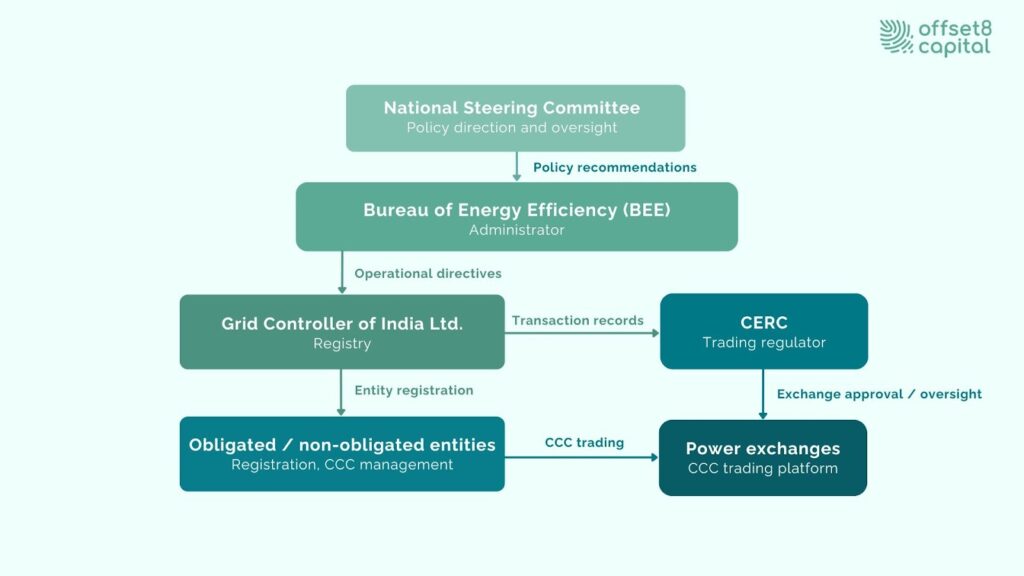
Fig1: CCTS governance structure
Pillar 1: The National Steering Committee (NSC-ICM) is the highest governance body of the Indian Carbon Market. Chaired by the Secretary of the Ministry of Power with the Secretary of the Ministry of Environment, Forest and Climate Change as Co-chairperson, it includes Joint Secretaries or above from the Ministry of Finance, NITI Aayog, the Ministry of Steel, the Ministry of Coal, the Ministry of Chemicals and Fertilizers, the Ministry of Petroleum and Natural Gas, and the Ministry of Agriculture and Farmers Welfare, among others. It plays a central role in setting the direction of the scheme — including formulating GHG emission targets, recommending the issuance of carbon credit certificates, and advising on international trading guidelines.
Pillar 2: The Bureau of Energy Efficiency (BEE) serves as the Administrator of the scheme. It oversees the bulk of operational functions, including identifying target sectors, developing emission reduction trajectories and targets, issuing carbon credit certificates, building market stability mechanisms, and accrediting carbon verification agencies (ACVA).
Pillar 3: Grid Controller of India Limited functions as the Registry, managing the carbon credit certificate database, registering entities, maintaining transaction records, and serving as India's meta-registry for national and international linkages.
Pillar 4: The Central Electricity Regulatory Commission (CERC) acts as the regulator for carbon credit certificate trading, overseeing transactions on Power Exchanges and conducting market surveillance to prevent fraud.
At the heart of the CCTS lies the Compliance Mechanism. Based on recommendations from BEE, the Ministry of Power determines the target sectors and obligated entities, and the Ministry of Environment, Forest and Climate Change notifies GHG emission intensity targets under the Environment Protection Act, 1986.
As of March 2026, GHG Emission Intensity (GEI) targets have been notified for entities across nine sectors (Aluminium, Chlor Alkali, Cement, Fertiliser, Iron & Steel, Pulp & Paper, Petrochemicals, Petroleum refinery, and textile). Obligated entities that achieve emission reductions beyond their targets receive carbon credit certificates, while those that fall short must purchase certificates from the Indian Carbon Market to cover the deficit.
According to the "Detailed Procedure for Compliance Mechanism under CCTS" published by BEE in July 2024, the key technical features of the Compliance Mechanism are as follows. The GHGs covered are currently limited to CO2 and PFCs (perfluorocarbons), with other GHGs to be added in the future. GEI targets are set for a three-year Trajectory Period, with annual targets assigned for each compliance year. A Gate-to-Gate boundary is applied for emissions calculation, where emissions from biomass and renewable energy are treated as zero, and CO2 transferred through CCUS (Carbon Capture, Utilization and Storage) is deductible. Furthermore, surplus carbon credit certificates (CCCs) can be banked for subsequent compliance years, to be used for future compliance or sold on the market.
Notably, a gradual transition from the existing PAT scheme to the CCTS Compliance Mechanism is planned. Nine sectors are earmarked for transition: aluminum, chlor-alkali, cement, fertilizer, iron and steel, pulp and paper, petrochemicals, petroleum refinery, and textiles, with additional sectors to be included in the future. While the PAT scheme was an energy efficiency-based market mechanism, the CCTS uses GHG emission intensity as a direct metric, thereby offering more comprehensive decarbonization opportunities.
The other pillar of the CCTS — the Offset Mechanism — is a voluntary system that allows non-obligated entities outside the scope of the Compliance Mechanism to register GHG emission reduction, removal, or avoidance projects and receive carbon credit certificates. It plays a complementary role in driving emission reductions from sectors not covered by the Compliance Mechanism, promoting economy-wide decarbonization.
The Offset Mechanism's target sectors are planned for phased expansion. Phase I covers six sectors: energy, industries, agriculture, waste handling and disposal, forestry, and transport. Phase II will add four areas: fugitive emissions, construction, solvent use, and CCUS (Carbon Capture, Utilization and Storage).
As of Prakriti 2026, nine methodologies have been notified, and over 40 entities have registered or submitted projects in areas including biogas, hydrogen, and forestry.
Under the CCTS Offset Mechanism, BEE has formally approved nine methodologies across five sectors. These form the foundation for projects eligible for carbon credit certificate issuance and effectively define the scope of the Indian Carbon Market.
Energy Sector (2 methodologies):
Industries Sector (2 methodologies):
Waste Handling and Disposal Sector (2 methodologies):
Agriculture Sector (1 methodology):
Forestry Sector (2 methodologies):
BEE has approved 12 general-purpose tools and 5 forestry-specific tools to support the application of these methodologies. General-purpose tools include the combined tool to identify the baseline scenario and demonstrate additionality (BM-T-001), the tool to calculate project or leakage CO2 emissions from fossil fuel combustion (BM-T-002), the tool for baseline, project and/or leakage emissions from electricity consumption and monitoring of electricity generation (BM-T-003), and the tool for project and leakage emissions from anaerobic digesters (BM-T-008), among others.
Forestry-specific tools cover estimation of non-CO2 GHG emissions resulting from burning of biomass (BM-T-AR-0002), estimation of carbon stocks and change in carbon stocks in dead wood and litter (BM-T-AR-0003), estimation of carbon stocks and change in carbon stocks of trees and shrubs (BM-T-AR-0004), estimation of the increase in GHG emissions attributable to displacement of pre-project agricultural activities (BM-T-AR-0005), and estimation of change in soil organic carbon stocks (BM-T-AR-0006).

India updated its NDCs (Nationally Determined Contributions) in 2022, setting targets to reduce the emissions intensity of GDP by 45% by 2030 (from 2005 levels) and to achieve 50% cumulative electric power installed capacity from non-fossil fuel energy sources by 2030. Having already achieved a 36% reduction in emission intensity by 2020, participation in Article 6 mechanisms is positioned as a means to support the achievement of these ambitious targets.
In the longer term, Article 6 activities are embedded as a key component of India's "Long Term – Low Carbon Development Strategy (LT-LEDS)" aimed at achieving net-zero by 2070.
India notified the National Designated Authority for the Implementation of Article 6 of the Paris Agreement (NDAIAPA) via Gazette Notification on May 30, 2022. The notification was amended on August 22, 2025, to reflect the latest decisions on Article 6.2 and Article 6.4 at COP 29.
NDAIAPA comprises cross-ministerial members including the Ministry of Environment, Forest and Climate Change, NITI Aayog, the Ministry of New and Renewable Energy, the Ministry of Power, the Ministry of External Affairs, the Department of Economic Affairs, the Department for Promotion of Industry and Internal Trade, the Ministry of Science and Technology, the Ministry of Steel, the Ministry of Petroleum and Natural Gas, the Ministry of Ports, Shipping and Waterways, the Ministry of Civil Aviation, the Ministry of Agriculture and Farmers Welfare, and the Bureau of Energy Efficiency. It holds the authority to decide the types of projects eligible for participation in the international carbon market under Article 6 mechanisms, and undertakes technical, financial, and sustainable development benefits evaluation of project proposals.
NDAIAPA has finalized 13 areas of activities eligible under the Article 6.2 and Article 6.4 mechanisms.
GHG Mitigation Activities (11 areas): Renewable energy with storage (stored component only), solar thermal power, offshore wind, green hydrogen, compressed biogas, emerging mobility solutions such as fuel cells, high-end technology for energy efficiency, sustainable aviation fuel (SAF), best available technologies (BAT) for process improvement in hard-to-abate sectors, tidal energy/ocean thermal energy/ocean salt gradient energy/ocean wave energy/ocean current energy, and high voltage direct current (HVDC) transmission in conjunction with renewable energy projects.
Alternate Materials (1 area): Green ammonia.
Removal Activities (1 area): Carbon Capture, Utilization and Storage (CCUS).
All of these technologies currently involve higher costs compared to their carbon-intensive alternatives. India's strategy is to leverage funding inflows through bilateral and multilateral frameworks under Article 6 to pave the way for large-scale deployment.
On August 7, 2025, India and Japan signed a Memorandum of Cooperation (MoC) to implement the Joint Crediting Mechanism (JCM). Under the JCM, each government maintains its own registry, and project participants submit reports to the Joint Committee to request the issuance of credits. Issued credits are allocated to the respective registries of India and Japan and may be used toward the NDCs of both countries. Measures to prevent double counting are also incorporated.
The first Joint Committee meeting was held on September 22, 2025, with ongoing discussions on the Rules of Implementation (RoI) and the development of the JCM manual describing project cycle procedures.
In addition to Japan, negotiations are ongoing with Singapore, Sweden, and South Korea for signing bilateral agreements under Article 6 of the Paris Agreement. The parallel pursuit of negotiations with multiple countries indicates India's intent to establish a strategic position in international carbon credit trading
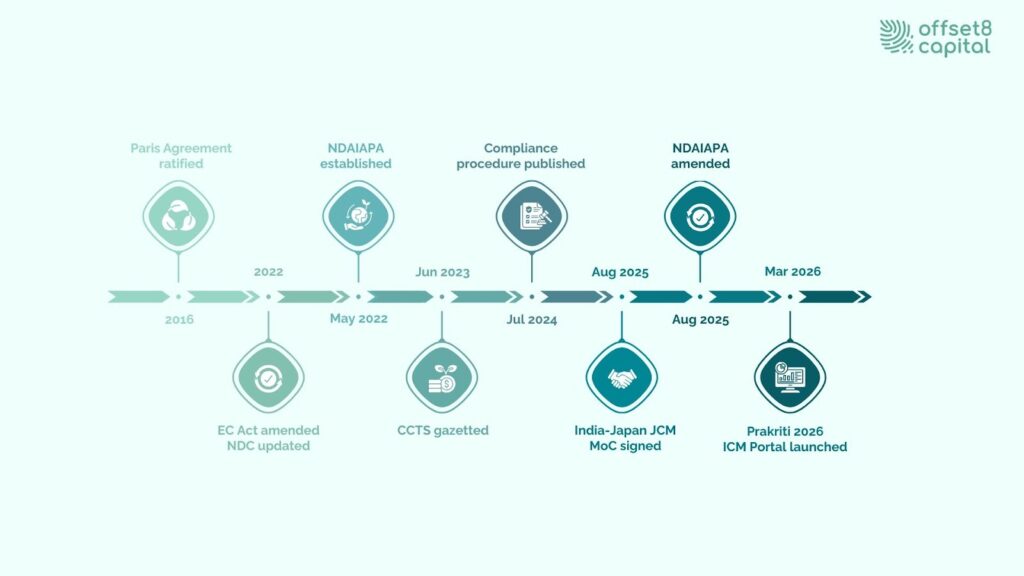
Fig 2: Key milestones in India's carbon market
The Indian Carbon Market Portal, developed under BEE's leadership, was officially launched at Prakriti 2026 in March 2026. The portal functions as the central platform for implementing and administering the Indian Carbon Market, with integration of Article 6 modules also planned.
At Prakriti 2026, Union Power Minister Shri Manohar Lal stated that "India is building a transparent and credible carbon market framework that will serve as a long-term national asset" through the Carbon Credit Trading Scheme. Minister of State for Power Shri Shripad Naik highlighted the "three Cs" essential for robust carbon markets: Credibility (through digital MRV for verifiable emission reductions), Capital (channeling funds into clean technologies), and Collaboration (via Article 6 of the Paris Agreement).

India's carbon market extends beyond a mere compliance system. As the Power Minister stated at Prakriti 2026, businesses should "view carbon markets not merely as a compliance requirement but as a strategic opportunity for innovation, investment, sustainable growth, and entrepreneurship." The scheme is designed as a comprehensive platform that also envisions the empowerment of MSMEs and farmers.
Methodology development is advancing in biogas, hydrogen, and forestry, with further expansion expected in emerging areas such as green hydrogen, SAF, and CCUS. International capital inflows through bilateral frameworks under Article 6 have the potential to accelerate the adoption of advanced decarbonization technologies that face high cost barriers.
Significant regulatory milestones have been reached since the CCTS framework was established. The GHG Emission Intensity Target Rules 2025 were gazetted, formally setting entity-level GEI targets for Compliance Years 2025–26 and 2026–27 across the nine obligated sectors. In parallel, BEE published the list of Accredited Carbon Verification Agency (ACVA) empanelled under the CCTS — a critical step toward operationalizing the validation and verification infrastructure required for credible market functioning.
That said, key market parameters remain outstanding. Floor and forbearance prices for carbon credit certificates have yet to be formally determined, and their establishment will be pivotal in anchoring price discovery, sustaining market liquidity, and building investor confidence going forward.
India is simultaneously building a domestic compliance market and entering international carbon credit trading. The scale of its domestic market with approximately 490 obligated entities, the 13-area activity list under Article 6, and the parallel pursuit of bilateral negotiations with Japan and other countries clearly demonstrate India's intent to become a major player in the global carbon market.
For carbon credit industry stakeholders, continuously monitoring the institutional design and progress of the Indian market will be an indispensable element in shaping future business strategies.
Disclaimer
This commentary is for informational purposes only and should not be considered financial, investment, or regulatory advice. Offset8 Capital Limited is regulated by the ADGM FSRA (FSP No. 220178). No assurances or guarantees are made regarding its accuracy or completeness. Views expressed are our own and subject to change
The Compliance Mechanism mandates obligated entities in energy-intensive sectors to achieve GHG emission intensity targets, while the Offset Mechanism allows non-obligated entities to voluntarily register emission reduction projects and obtain carbon credit certificates. The two mechanisms complement each other to promote decarbonization across the entire Indian economy.
The most concrete pathway is through bilateral crediting mechanisms (JCM) under Article 6 of the Paris Agreement. A Memorandum of Cooperation was signed between India and Japan in August 2025, negotiations are ongoing with Singapore, Sweden, and South Korea, and India has approved 13 areas as eligible activities under Article 6.
Two key areas: the finalization of detailed procedures including floor and forbearance prices for carbon credit certificates, and the progress of the gradual transition from the PAT scheme to the CCTS across nine sectors.

