
October 22, 2026
Osaka Gas Co., Ltd.
Offset8 Holding Limited
Osaka Gas Co., Ltd. (President and CEO: Masataka Fujiwara; hereinafter “Osaka Gas”) has entered into an agreement with Offset8 Holding Limited (UAE; Co-Founder & Director: Jules Thierry Michel Maitrepierre; hereinafter “Offset8”), a commodity trading company, to provide biodiversity assessment technology (hereinafter the “Technology”) for a methane emission reduction project in rice paddies in Indonesia (hereinafter the “Project”). The Project is being promoted by Offset8 and SAWA EcoSolutions Pte Ltd (Indonesia; hereinafter “SAWA”), a climate tech company, and utilizes Alternate Wetting and Drying (AWD), an irrigation technique designed to reduce methane emissions from rice cultivation.
The Technology analyzes trace amounts of genetic material from organisms (environmental DNA, or eDNA*1) to visualize and assess impacts on ecosystems and biodiversity. In addition to reducing methane emissions through AWD, the Technology enables the generation of carbon credits that incorporate biodiversity-related value.
Osaka Gas will support the development of the Project and plans to purchase a portion of the credits expected to be generated by the Project through the Joint Crediting Mechanism (JCM*2). This will be the first generation of JCM credits in Indonesia applying the Technology.
■ Background
AWD, one of the JCM methodologies in the agricultural sector, is a technique for reducing methane emissions from rice cultivation. It involves periodically draining rice paddies to allow the soil to dry before reflooding them during the rice-growing season. AWD is reported to reduce methane emissions by approximately 30% compared with continuously flooded rice paddies.*3 Indonesia is one of the world's major rice-producing countries, and reducing methane emissions from rice cultivation is an important part of decarbonizing the agricultural sector.
Meanwhile, concerns have been raised that changes in paddy field conditions resulting from AWD may affect local ecosystems. To promote the wider adoption of AWD, it is important to assess and address its impact on biodiversity. Osaka Gas has been working to evaluate both methane emission reductions and biodiversity impacts associated with AWD in rice paddies in Japan and overseas, contributing to the generation of carbon credits that incorporate biodiversity-related value.*4
■ About the Project
In this Project, SAWA will work with Himpunan Kerukunan Tani Indonesia (hereinafter “HKTI”), a nationwide agricultural organization established in 1973 with more than 50 years of experience. Leveraging HKTI’s network across 38 provinces of Indonesia, the partners will identify farmers and rice fields suitable for AWD implementation and support its adoption. Offset8 will provide investment and financing support for the Project.
Osaka Gas will provide the Technology as a service to analyze and visualize changes in the biodiversity of organisms inhabiting rice paddies. By analyzing and comparing environmental DNA found in paddy water before and after AWD implementation, including DNA from organisms such as dragonflies and frogs, the Technology can assess ecosystem conditions and the impacts on biodiversity. This information can help prioritize conservation activities and evaluate the effectiveness of environmental measures. Leveraging the expertise it has developed through other projects*4 in achieving both methane emission reductions and biodiversity conservation in rice paddies, Osaka Gas aims to generate JCM credits that incorporate biodiversity-related value.
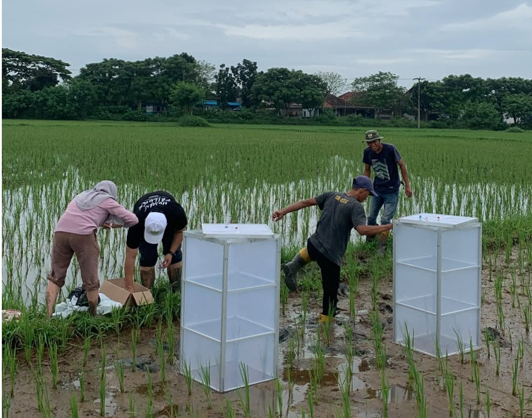
Methane concentration measurement in a rice paddy implementing AWD (Indonesia)
■ Comments on the Project by Abdul Karding, Secretary General of HKTI and Head of Indonesian Quarantine Authority
At HKTI, our guiding principle has always been simple: how can we improve farmers’ livelihoods, safeguard national food security, and keep our soil fertile for generations to come?
HKTI has officially joined hands with SAWA EcoSolutions to implement environmentally friendly rice cultivation practices across 500,000 hectares of farmland. This technical approach in the fields can have a significant impact. In addition to saving water, we aim to reduce carbon emissions by up to 3 million tonnes per year.
This is not simply a matter of signing an agreement on paper. HKTI members will work directly in the field alongside agricultural extension officers, supporting farmers to ensure that the benefits are truly reflected in their livelihoods and crop yields.
■ Future Developments
Through this Project, Osaka Gas will contribute to the wider adoption of AWD and work to create new environmental value through the use of the Technology. The Company will continue to expand the application of the Technology across carbon credit projects in Japan and overseas, contributing to both decarbonization and biodiversity conservation.
Through AWD in Indonesia, and with Osaka Gas and SAWA, Offset8 aims to strengthen its presence in the Japanese compliance carbon market while expanding its global portfolio of high-integrity carbon credits, delivering tangible benefits to both local communities and the environment.
*1: A general term for DNA released into the environment, including water, soil, and air.
*2: A mechanism under which Japan and its partner countries cooperate to reduce greenhouse gas emissions and share the resulting reductions between the two countries. In February 2025, the Japanese government approved a target of securing cumulative greenhouse gas emission reductions and removals of approximately 100 million t-CO₂ by FY2030 and approximately 200 million t-CO₂ by FY2040 through the JCM. The JCM is also intended to contribute to achieving Japan’s Nationally Determined Contribution (NDC).
*3: See the Ministry of Agriculture, Forestry and Fisheries of Japan, “Reducing Methane Emissions from Rice Paddies through Alternate Wetting and Drying (AWD)” (June 2025).
*4: The Technology has been introduced in multiple methane emission reduction projects in the Philippines and Japan. For details, please refer to the URLs below.
https://www.osakagas.co.jp/company/press/pr2025/1796693_58387.html
https://www.osakagas.co.jp/company/press/pr2025/1796693_58387.html

